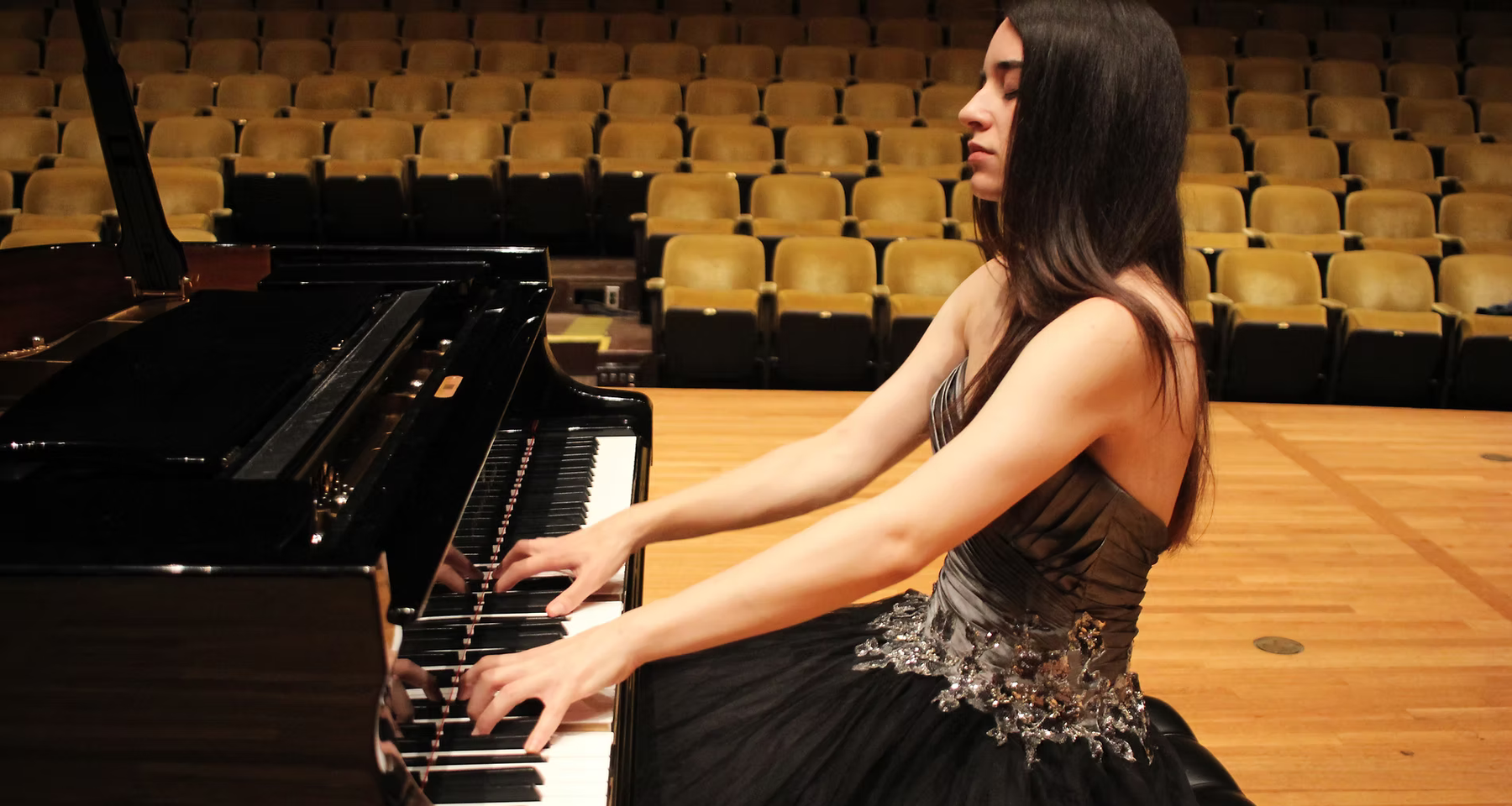
Theodora Serbanescu-Martin: The Romantic Salon: Brahms & the Art of Difficulty
Flatiron, New York
Sun, November 15, at 5:00 PM, EST
- Alcoholic and non-alcoholic drinks provided
-
Wheelchair access
- Wheelchair Accessible

This is a groupmuse
A live concert in a living room, backyard, or another intimate space. They're casual and friendly, hosted by community members.
Host

5 PM Doors & Pre-Reception
6 PM Performance
8 PM Post-Reception
Theodora Serbanescu-Martin: The Romantic Salon: Brahms & the Art of Difficulty
Gotham Arts in collaboration with Groupmuse is delighted to present The Romantic Salon: Brahms & the Art of Difficulty, an intimate private lecture and solo recital by pianist Theodora Serbanescu-Martin featuring works by Brahms.
Wine will be served.
Program
BACH-BRAHMS Chaconne from Violin Partita No. 2 in d minor, BWV 1004 (arranged by Brahms for the left hand alone)
BRAHMS Fantasies, Op. 116
BRAHMS Variations and Fugue on a Theme by Handel, Op. 24
Other selected works by Brahms
About the Artist
Watch Theodora perform Brahms' Klavierstücke, Op. 116 on a historic Streicher piano from 1857
Theodora Serbanescu-Martin is a pianist, musicologist, and interdisciplinary scholar whose work bridges performance, literary studies, material culture, and the history of embodiment. She is completing her PhD in Music and Sound Studies at Cornell University (degree expected spring 2026), and holds dual BA degrees in Music and English, with a minor in German Studies, from the University of California, Berkeley.
Her doctoral dissertation, Fashionable Concealments: Myth, Material, and Method in Nineteenth-Century Pianism, reconstructs the piano as a cultural instrument situated at the intersection of fashion, discipline, literature, and technique. Moving beyond genealogical narratives of virtuosity, the project examines how bodies, clothing, and technologies shaped Romantic ideals of expression, authenticity, and labor. This research forms the basis of her forthcoming book project, Fashioning Pianism: The Media of Romantic Virtuosity. Her scholarship will also appear in the Oxford Handbook of Arrangement Studies (Oxford University Press), with a chapter titled "Effortful Reductions: Brahms’s Piano Transcriptions and the Notation of (Dis)Ability," and in the Nineteenth-Century Music Review.
At Cornell, Theodora served as assistant curator for the exhibition Sounding Fashion and was the organizer of the conference-festival Performing Clara Schumann. Her research has been supported by the American Musicological Society's Elizabeth C. Bartlet Fund, the Institute for European Studies, the Timothy Murray Fellowship, and the Cornell Council for the Arts. She regularly presents lecture-recitals and conference papers that integrate historicist reading, performance analysis, and archival work.
As a performer, Theodora identifies as a "Romantic pianist" — a term she uses to describe an approach grounded in nineteenth-century aesthetics of flexibility, virtuosity, improvisation, and expressive risk, while remaining critically aware of Romanticism's afterlives and ideological consequences. Her performances do not claim historical "authenticity," but instead treat Romantic materials as living, mediated practices shaped by context, technology, and embodiment. She is particularly interested in how visual, literary, and material dimensions—dress, gesture, space, and staging—shape musical meaning.
She has appeared internationally throughout Europe and the United States and has performed with ensembles including the UC Berkeley Symphony Orchestra, the Peninsula Symphony, the Saratoga Symphony, the Lublin Philharmonic, and the Kostroma Symphony with repertoire such as Brahms's Second and Prokofiev's Second concertos, as well as extra-canonical repertoire. Currently, she is working on a recording and critical edition of Hélène de Montgeroult's seminal but forgotten method Cours complet pour l’enseignement du forte piano, while preparing performances of Marie Jaëll's rarely heard first concerto, Liszt's De Profundis psalm-concerto, and other virtuoso repertoire including Alkan. Her performance work has been recognized with prizes at competitions such as the International Los Angeles Liszt Competition, IPC Sussex, and MTAC competitions, and with scholarships at festivals such as the Dublin International, American Fine Arts Festival, and Freiburg International, and the California Summer Music chamber festival. She collaborates regularly with historical keyboard collections, including Cornell's Center for Historical Keyboards, the Westfield Center, and the Ira F. Brilliant Beethoven Center, and is currently in town for the event The Sociable Fortepiano, where she is presenting work on nineteenth-century finger-strengthening devices, Romantic virtuosity, and fashion at the keyboard.
What's the music?
~ Introduction & Discussion ~
Brahms, after J. S. Bach — Chaconne in D minor for the left hand alone
Brahms — Theme and Variations in D minor, Op. 18b (1860)
(after the second movement of the String Sextet No. 1 in B-flat major, Op. 18)
Brahms — Fantasien, Op. 116 (1892)
I. Capriccio in D minor — Presto energico
II. Intermezzo in A minor — Andante
III. Capriccio in G minor — Allegro passionato
IV. Intermezzo in E major — Adagio
V. Intermezzo in E minor — Andante con grazia ed intimissimo sentimento
VI. Intermezzo in E major — Andantino teneramente
VII. Capriccio in D minor — Allegro agitato
~ Small Break ~
Brahms — Variations and Fugue on a Theme of Handel, Op. 24
Where does this music come from?
"Brahms & the Art of Difficulty"
What happens when difficulty is not something a pianist simply overcomes, but something the music asks us to hear?
In this Romantic Salon, pianist and musicologist Theodora Serbanescu-Martin brings Brahms’s music into conversation with the images, objects, texts, and bodily disciplines that surrounded nineteenth-century pianism. The program moves from Brahms’s extraordinary left-hand transcription of Bach’s Chaconne through the Theme and Variations from the First String Sextet, the late Fantasien, Op. 116, and the monumental Variations and Fugue on a Theme by Handel, Op. 24.
The concert takes the salon not straightforwardly as a resurrected historical setting, but as a way of thinking: a space in which music, literature, visual art, material objects, archival traces, and spoken commentary can speak across media without collapsing into a single explanation. An engraving of a grotesque figure by Jacques Callot; the invocation of a thumbscrew; exercises, manuscripts, historical accounts of injured hands, and other remnants of pianistic practice appear alongside the music as more than accessories: as parallel forms of knowledge that reshape the cosmology of difficulty.
Across the program, a hidden continuum emerges between exercise, transcription, variation, and fantasy. Brahms repeatedly turns constraint into invention: one hand must suggest the fullness of Bach’s Chaconne; six instrumental voices are compressed onto a single keyboard; late fantasies conceal the logic of technical exercise; Handel’s theme is subjected to increasingly elaborate transformations until the vehicle of variation starts to reassemble and script bodily discipline.
"Brahms & the Art of Difficulty" asks us to hear virtuosity differently. Rather than imagining technique as effortless mastery or seamless execution, the salon attends to repetition, friction, weight, compression, adaptation, and strain—to the moments when the labor of making music remains audible and becomes expressive in its own right.
Location
Exact address sent to approved attendees via email.
This is a groupmuse
A live concert in a living room, backyard, or another intimate space. They're casual and friendly, hosted by community members.
Host
Attendees

 Continue with Facebook
 Continue with Google
 Continue with Apple
Comments
Comment sections are only for participants. Please sign in and purchase tickets above to view comments.