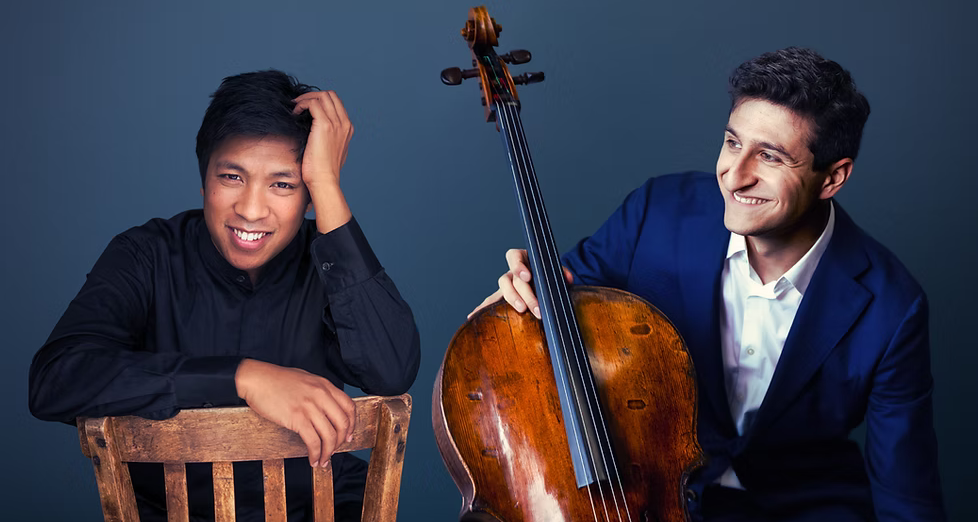
Josh Halpern & Yannick Rafalimanana: Letters to My Daughters
Flatiron, New York
Fri, September 25, 2026, at 7:00 PM, EDT
- Alcoholic and non-alcoholic drinks provided
-
Wheelchair access
- Wheelchair Accessible

This is a groupmuse
A live concert in a living room, backyard, or another intimate space. They're casual and friendly, hosted by community members.
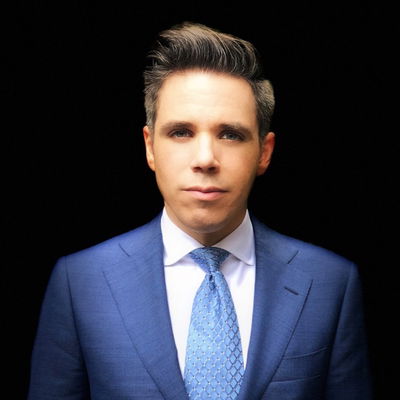
Host
7 PM Doors & Pre-Reception
8 PM Performance
10 PM Post-Reception
Josh Halpern & Yannick Rafalimanana: Letters to My Daughters
Gotham Arts in collaboration with Groupmuse is excited to present an intimate private duo recital by cellist Josh Halpern and pianist Yannick Rafalimanana comprising music written at times of profound sociopolitical uncertainty. The program will include world premieres of three works composed for Josh with the centerpiece Scott Ordway's Letters to My Daughters composed through a profoundly personal collaboration with Josh.
Wine will be served.
Program
DEBUSSY Cello Sonata in d minor
1. Prologue: Lent, sostenuto e molto risoluto
2. Sérénade: Modérément animé
3. Finale: Animé, léger et nerveux
MESSIAEN "Praise to the Eternity of Jesus" from Quartet for the End of Time
BERNSTEIN Three Meditations from MASS
1. Meditation No. 1: Lento assai, molto sostenuto
2. Meditation No. 2: Andante sostenuto —
3. Meditation No. 3: Presto — Fast and Primitive — Molto adagio
BRUCE ADOLPHE Thakla III*
ILSE WEBER (arr. Henrique Eisenmann) Three Songs*
1. Wiegala
2. Und der Regen rinnt
3. Ich wandre durch Theresienstadt
Intermission
SCOTT ORDWAY Letters to My Daughters*
1. Ring All the Bells
2. I Love Telling You Things
3. Tell the Truth
4. I Will Always Love You
5. The World is Bright
* World premiere / composed for Josh
About the Program
Watch a first-look trailer for Letters to My Daughters featuring Josh and composer Scott Ordway
Letters to My Daughters
Episode I of In Real Time, a collaborative new music project
Letters to My Daughters is not only my first commissioning project, it’s a profoundly personal collaboration with my friend, Scott Ordway. As I seem to lack any inclination to compose myself, this was an immensely satisfying project that brought me — and the audience — directly into Scott’s creative space, using his most personal relationships as an entryway.
But first, a general introduction: I’ve long wondered why we tend to pour time, money, and immense effort into supporting new commissions only to sneakily wedge them among more "palatable" pieces, thereby requiring audiences to hear something new without context or, often, even an invitation. Why not make the commission the centerpiece, building a cohesive program around it in order to prime the listener to receive the new work as openly as possible? Better yet, why not make the composer the centerpiece, as if we could open a hatch at the top of their head and allow their life experiences, inspirations, and musical influences to pour out and assemble themselves into not only a vibrant program, but a kind of musical self-portrait?
I first met with Scott to discuss this project in November 2024. Like so many, Scott was reckoning with the uncertainty of the world—in particular, how to discuss it with his two daughters, four and seven at the time. Rather than a broad exhibition of Scott’s life and influences, our collaboration began to take shape as a love letter, time capsule, and urgent appeal to decency for his girls.
He began by writing five real letters — and was generous enough to allow me to serve as his editor. We discussed their content and intention over long calls and essayistic email threads. I found these exchanges tremendously cathartic despite having no children of my own. Not only did his feelings so closely mirror mine, but our questions increasingly led us away from defensiveness and toward kindness, generosity, and humility: Can we experience wonder and optimism in the face of fear and uncertainty? How might we find courage in the face of failure, injustice, or threat of harm? How do we foster and preserve reservoirs of goodness and decency in ourselves and each other? How do we tell people that we love them?
In a similar way, the larger program became brighter as we refined it. We began with, among othe ideas, the concept of a triptych of Eastern Bloc composers: 45 minutes of uninterrupted pitch-black music for solo cello by Valentin Silvestrov, Sofia Gubaidulina, and Alfred Schnittke. An interesting concept, perhaps, but as a friend asked me, “do people want that right now? Do you?” We went back to the drawing board.
We finally arrived at a program comprising music written at times of profound sociopolitical uncertainty. Debussy’s Cello Sonata, a vibrant and unexpected suite composed as the global social order was being redefined by World War I; Messiaen’s slow, transcendentally still yet ecstatic meditation for cello and piano from his Quartet for the End of Time, a masterpiece born within a prisoner of war camp that Alex Ross described as “the music of one who expects paradise not only in a single awesome hereafter but also in the happenstance epiphanies of daily life;” Bernstein’s Three Mediations from MASS, wordless reflections on the seed of faith each of us must find when our ancient rituals unravel under the weight of doubt, dissent, and disillusionment; three songs by Ilse Weber—a nurse and music teacher at Theresienstadt later sent with the children in her care to the gas chambers at Auschwitz—gorgeously reimagined by my friend, the brilliant jazz pianist Henrique Eisenmann; and finally, a lament named after the Arabic word for a mother’s grief over her dead child, composed for me by Bruce Adolphe.
It is a stunning, devastating, and ultimately uplifting program about love and resilience. And by mining this contemporary moment through the lens of Scott’s paternal love for his daughters, we created a communal experience that was simultaneously intensely intimate and profoundly universal.
— Josh Halpern
About the Artists
About Josh Halpern
Joshua Halpern has appeared on stages around the world as a soloist, chamber musician, and orchestral principal cellist. As a chamber musician, he has collaborated with artists including Jonathan Biss, Anthony Roth Costanzo, Roberto Díaz, Viviane Hagner, Gary Hoffman, Kim Kashkashian, Patricia Kopatchinskaja, Anthony McGill, Olli Mustonen, and Itzhak Perlman, and appeared at music festivals including the Ravinia Steans Institute, Music@Menlo, the Perlman Chamber Music Workshop, the New York String Orchestra Seminar, the Taos School of Music, La Jolla Summerfest, Musikiwest, and Krzyzowa-Music, with whom he has also toured extensively. An eager advocate of contemporary music, he has worked personally with composers such as Richard Danielpour, Scott Ordway, Kevin Puts, Dai Wei, Nick DiBerardino, and Kaija Saariaho. During the 2019 season he served as guest principal cello of the Rotterdam Philharmonic Orchestra, including on tours to Germany, Taiwan, and China, and in 2020 served as cellist with the Banff Competition-winning Rolston Quartet. In 2023, he appeared numerous times as guest principal cello with the Philharmonia Orchestra in London, as well as guest with the Varian Fry Quartet; the 12 Cellists of the Berlin Philharmonic; and in Greece, Spain, and Germany with Curtis On Tour.
Josh completed his Artist Diploma at The Curtis Institute of Music in Philadelphia, where he performed throughout the United States, Europe and Latin America with Curtis On Tour, and served as principal cello of the Curtis Symphony Orchestra during the 2016/17 season. At Curtis he studied with Carter Brey and Peter Wiley. As an undergraduate at the Shepherd School of Music at Rice University, he studied with Desmond Hoebig and won the school's concerto competition. From 2021 until 2023, he was a member of the Karajan Akademie of the Berliner Philharmoniker, in which he played as a member of the Berliner Philharmoniker and was mentored by Ludwig Quandt.
In 2018, Josh curated a solo tour across Colorado to bring classical music to unexpected places, including the state penitentiary, small-town saloons, bicycle shops, and more. Since then, he has continued bringing music to unique spaces, fostering connection and conversation with all types of people along the way. In 2021, he founded the Cultural Caravan, a Colorado-based organization operating at the intersection of small businesses, social-service nonprofits, municipal organizations, and local artists. The Cultural Caravan has since presented over 80 artists with backgrounds ranging from Zimbabwean Afropop to Venezuelan jazz to Classical Music in concerts in coordination with over 60 local businesses and community organizations, reinvesting over $500,000 into the community to date.
As a teacher, Josh has presented master classes throughout the United States and South America and has taught at Curtis Summerfest, the Green Mountain Chamber Music Festival, and on faculty at the Brooklyn School of Music. He lives in Brooklyn, New York.
Josh performs on a cello made by Domenico Busan, likely in the 1750s. This cello was the primary instrument of Josh's teacher while at Rice University, Desmond Hoebig—former principal cellist of the Cincinnati, Houston, and Cleveland Orchestras. This cello is provided to Josh on a generous long-term loan from a member of the Stretton Society. Josh plays on a modern bow by a Swiss maker named Pierre-Yves Fuchs.
About Yannick Rafalimanana
French pianist Yannick Rafalimanana has developed an international concert career as a recitalist and chamber musician. Recent performances have taken him to halls all over the world, including the Berlin Philharmonie, the Elbphilharmonie Hamburg, Wigmore Hall, Konzerthaus Berlin, Köln Philharmonie, the Vienna Konzerthaus, the Shanghai Symphony Orchestra Chamber Hall, and the Kennedy Center in Washington. He has made chamber music with countless artists, including Kim Kashkashian, Steven Isserlis, Noah Bendix-Balgley, Arnold Steinhardt, and Itzhak Perlman.
As a soloist, he has appeared with the Berlin Konzerthaus Orchestra, the Orchestre CNR de Lille, Orchestre Impromptu, the Ensemble Parisien. He has worked under the batons of Péter Eötvös, Maxime Pascal, Jean Deroyer, Lucie Leguay and Zolt Nagy. Yannick regularly appears at a wide variety of summer festivals, including the Perlman Music Program, the Great Lakes Chamber Music Festival, Schleswig-Holstein Musikfestival, Festspiele Mecklenburg-Vorpommern, Osterfestspiele Baden-Baden, Sommerliche Hitzacker Musiktage , OCM Prussia Cove and Krzyzowa-Musik Festival.
Yannick is the winner of numerous awards and prizes, including the Borromeo Quartet Guest Artist Award, the Bruxelles J-Musiciens Competition, the Brest Piano Competition, and the International Ravel Academy's Rotary-Lions Competition. As the first prize winner of the 2012 Tufts/New England Conservatory Soloist Competition, he made his U.S. concerto debut in Symphony Hall in Boston, playing the Schumann Concerto with the Boston Pops Orchestra and Keith Lockhart.
Born in Lille, he began his musical studies at the Conservatory of Lille under the tutelage of Alain Raes. He later graduated from the Paris Conservatoire with first prizes in piano performance, chamber music, and collaborative piano performance. His teachers there included Bruno Rigutto, Michael Levinas, and Jean-Claude Pennetier. His chamber music and collaborative piano coaches included Francois Salque, Michel Moraguais, David Walter and Jean Koerner. Yannick then moved to Boston, where he obtained a graduate diploma from the New England Conservatory in piano performance and a master of music in chamber music as a student of Vivian Weilerstein.
Yannick has been teaching Chamber Music at the Folkwang University of Arts in Essen from 2015 to 2018.
In 2022, he launched a concert series in his Berlin neighborhood called "Yannick’s Salon" bringing Chamber Music masterpieces to the local audience of Weissensee.
What's the music?
Claude Debussy: Cello Sonata in D minor, L. 135
I. Prologue: Lent, sostenuto e molto risoluto
II. Sérénade: Modérément animé
III. Finale: Animé, léger et nerveux
Leonard Bernstein: Three Meditations from Mass
I. Meditation No. 1: Lento assai, molto sostenuto
II. Meditation No. 2: Andante sostenuto —
III. Meditation No. 3: Presto — Fast and Primitive — Molto adagio
Bruce Adolphe: Thakla III
Ilse Weber (arr. Henrique Eisenmann): Three Songs
I. Ich wandre durch Theresienstadt
II. Und der Regen rinnt
III. Wiegala
Intermission
Letters to My Daughters
I. Ring All the Bells
II. I Love Telling You Things
III. Tell the Truth
IV. I Will Always Love You
V. The World is Bright
Where does this music come from?
Letters to My Daughters is not only my first commissioning project, it's a profoundly personal collaboration with my friend, Scott Ordway.
In classical music, we pour so much time, money, and effort into supporting new commissions only to hide them among more "palatable" pieces. It forces audiences to hear something new without context or even an invitation. Why not make the composer the centerpiece, as if we could open a hatch at the top of their head and allow their life experiences, inspirations, and musical influences to pour out and assemble themselves into a kind of musical self-portrait?
I first met with Scott to discuss this project in November 2024. Like so many, Scott was reckoning with the uncertainty of the world—in particular, how to discuss it with his two young daughters. Rather than a broad exhibition of Scott's life and influences, our collaboration began to take shape as a love letter, time capsule, and urgent appeal to decency for his girls.
He began by writing five real letters. These letters asked questions we're all asking these days: Can we experience wonder and optimism in the face of fear and uncertainty? How might we find courage in the face of failure, injustice, or threat of harm? How do we foster and preserve reservoirs of goodness and decency in ourselves and each other? How do we tell people that we love them?
This program comprises music written at times of profound sociopolitical uncertainty. Debussy's Cello Sonata, composed as the global social order was being redefined by World War I; Bernstein's Three Meditations from MASS, reflections on the faith we seek when our ancient rituals are unraveled by doubt, dissent, and disillusionment; three songs by Ilse Weber—a nurse and music teacher at Theresienstadt who died at Auschwitz—reimagined by my friend, the genius jazz pianist Henrique Eisenmann; and finally, a lament named for the Arabic word for a mother's grief over the loss of her child, composed for me by Bruce Adolphe.
We premiered this project in the summer of 2025. Now, as we prepare to transform it into a commercial recording, I'm thrilled that my close friend and favorite collaborator, the French pianist Yannick Rafalimanana, will join me for this performance and our upcoming studio album.
This project has yielded a stunning, devastating, and ultimately uplifting program about love and resilience. And by mining this contemporary moment through the lens of Scott's love for his daughters, we have created something intimate and universal.
— Josh Halpern
Location
Exact address sent to approved attendees via email.
This is a groupmuse
A live concert in a living room, backyard, or another intimate space. They're casual and friendly, hosted by community members.
Host
Attendees


 Continue with Facebook
 Continue with Google
 Continue with Apple
Comments (1)
Comment sections are only for participants.